
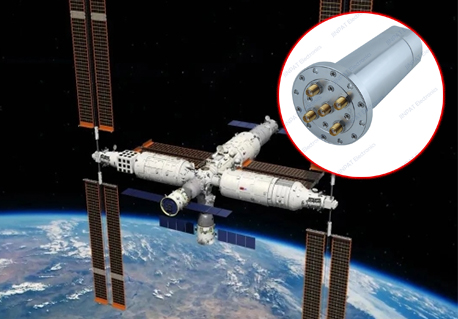
Slip rings play a crucial role in spacecraft
As professionals in the slip ring industry,we understand the importance of slip rings in spacecraft. However, due to theextreme temperature variations in the outer space environment, aerospace sliprings demand much stricter quality standards compared to those on Earth. Afterall, slip rings operating within the atmosphere can be repaired, allowing for acertain margin of error and failure rate. In contrast, if an aerospace slipring fails, it could render the spacecraft inoperable or even cause it to be scrapped.Unless it’s a manned space station that allows for limited repairs, slip ringson other spacecraft must achieve near 100% reliability.
In critical subsystems of spacecraft suchas attitude control systems, gimbals, and solar panel connections, aerospaceslip rings or rolling rings are indispensable. The function of these componentsis similar to that of slip rings used within the atmosphere, as they are bothused to transmit signals and power. However, the space environment presentssome unique challenges. For instance, in scenarios where power and signals aretransmitted together, either slip rings or rolling rings can be used.
For large spacecraft, due to the need totransmit large amounts of power between rotating joints, carbon brush sliprings are typically used within the atmosphere to solve this problem. Althoughthere are cases of carbon brush slip rings being used in space, the vacuum andweightless environment can cause carbon brushes to generate carbon dust during operation.If wear is severe and sealing is poor, this may lead to short circuits.Additionally, carbon brush slip rings take up more space, and spacecraft havevery strict space and weight requirements.
In this situation, rolling rings become theideal solution. Due to their structural advantages, rolling rings can transmitfar more power than ordinary slip rings of the same size, meeting the needs forhigh-power rotational transmission in spacecraft. Moreover, rolling rings donot use carbon brushes, so they do not produce carbon dust, and theirreliability is significantly higher than that of carbon brush slip rings.
As an established manufacturer with nearly30 years of experience in the industry, JINPAT has strong R&D capabilitiesand extensive experience in developing slip rings resistant to extremetemperatures. JINPAT is fully capable of developing aerospace slip rings thatcan withstand the high and low-temperature impacts of outer space.
Name
Email*
*Phone
Application
Message
*
